
Resources
How to choose lighting, house numbers, hardware, paint, planting and repairs once you know your direction.
Last reviewed September 11, 2026 · AI concept imagery
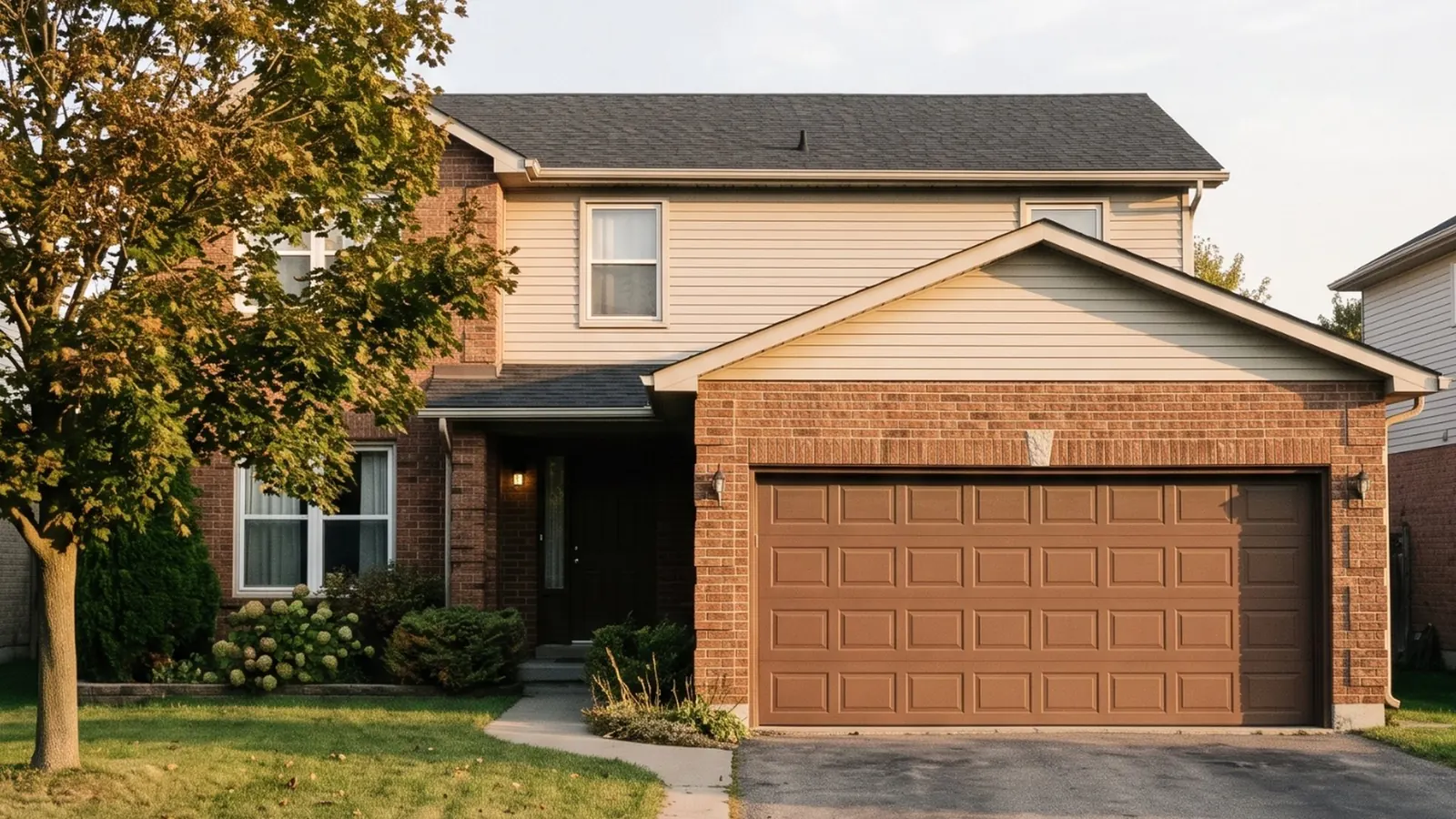
This is House A from the Planner. The garage door is the first thing you see, and the front door sits back in the shade. Its direction is to make the entrance the brightest thing on the front, and we use that direction as the example on this page.
AI concept visualization for inspiration. The source house is fictional.
Exterior shopping often starts with a real problem and ends with whatever looked good in the store. Something needs to change, so you start looking at products, and before long the products are shaping the decision. A year later the purchase is still there, and it hasn’t changed much about how the front of the house reads.
It helps to set a filter before you shop, and it comes down to two questions. What does this item have to do with the thing you decided matters? And what does that decision rule out? The second question tends to be the more useful one, because if your direction can’t tell you what to skip, it probably needs to be narrower.
Below, we go through six categories: what each one is for, what separates a good choice from an expensive mistake, and when an item on your list is really a question for someone else. Each one is labelled with the tension families from the Planner that it usually helps with.
If you’re working from the Planner
Your two fields on page 25 are the filter. “What it means I will do” names the categories that are in, and “What it rules out” names the ones that are out. Read them together before anything below. You don’t need this page to finish the Planner.
First, the Items That Aren’t Shopping Questions
Some things on a list look like purchases but start with a question. A light fixture for a recess with no wiring in it starts with a wiring question. A planting bed over a drain starts with a drainage question, and a new surface over a slab that might be moving starts with a question about the slab.
Buying first can leave a boxed fixture sitting in the garage for a season. If an item depends on an answer you don’t have yet, make the call before you shop.
Exterior suitability, structure, drainage, safety, code and accessibility require local professional evaluation.
Tension family · Entrance and route
Entrance Lighting
Light changes where the eye goes after dark, which is why it comes up in so many directions. It’s also easy to spend money on it without getting that result.
We’d look at aim first, which the drawing covers. Colour and scale are the other two things a store display won’t show you. Warm light keeps brick, stone and wood close to their daytime colours, while cool white light can make them look grey and flat. Most fixtures also look larger in the store than they will beside a door, so hold the box or a paper cut-out at the right height before you buy. A fixture that seems slightly too big up close often looks right from the street.
Two labels help in the store. A fixture described as fully shielded, or one carrying the DarkSky Approved seal, keeps its light pointed down. For warmth, check the colour temperature printed on the box or the bulb: DarkSky recommends 3000 K or lower for homes, and a lower number looks warmer.
Solar and battery fixtures avoid the wiring question, which helps. The tradeoff is less light, and less reliable light through a northern winter, when the evenings are longest. For some entrances that’s still a reasonable choice, as long as you make it knowing the limits.
The check: stand at the curb after dark and ask two things. Can you see where the door is, and can you see the ground between you and it? If only one answer is yes, each one calls for a different fix.
Tension family · Entrance and route
House Numbers
Numbers are usually the least expensive category here, and they often do a lot of work. Some styles that look good in photos are hard to read from a moving car, so it’s worth testing readability before you settle on a style.
Contrast matters more than size, as the two panels show. Placement comes close behind: put the numbers where a visitor is looking as they approach, which isn’t always the centre of the house. Unlit numbers only help in daylight, so light them, place them where an existing fixture already reaches, or accept that limit.
Standoff numbers, mounted a little away from the wall, cast a shadow that can sharpen them in daylight and blur them under a downlight at night. Flush-mounted numbers behave the opposite way.
The check: drive past at dusk at normal traffic speed, or ask someone who doesn’t know the house to do it. Many fire codes in North America ask for numbers at least 4 inches (about 10 cm) tall, in a colour that contrasts with the background and visible from the street. Your own municipality’s rule is the one that applies, so check it before you buy.
Tension family · Detail coherence
Door Hardware
Door hardware is small, but it’s seen up close and touched every day, so it carries more weight than its size suggests. It’s also where a little coordination makes a visible difference for not much money.
Count the metal finishes you can see from the curb. The handle, light fixture, house numbers and mailbox are often bought years apart, and four different finishes tend to look collected over time rather than chosen. Two finishes usually look settled, and one deliberate difference, like a dark handle with warmer numbers, still reads as a choice. By three or four, the mix starts to look accidental.
Check fit before finish. The size of the hole in your door (the bore) and its distance from the door’s edge (the backset) decide which handlesets will fit without new drilling. Most North American residential doors have a 2 1/8-inch bore and a backset of either 2 3/8 or 2 3/4 inches, and handleset packaging lists which ones it fits. A mismatch is a common reason a new handleset goes back to the store.
The check: photograph the front from the sidewalk and count the finishes in the picture. It’s a useful number to know before you buy the next piece.
Tension families · Materials and colour, Garage and massing
Paint
Paint can change a lot for the money, and it’s often chosen from the wrong evidence: a chip under store lighting, or a photo of a different house facing a different direction.
Light reflectance value (LRV) is a number from 0 to 100 that paint makers publish for most of their colours. It tells you how much light a colour reflects, with black near 0 and bright white near 100. On a house, what matters is the gap between surfaces that sit side by side. A garage door with a value close to the wall around it tends to blend in, and a large gap makes it stand out. If you’re trying to stop the garage door from dominating the front, that gap tells you more than the colour name does.
Test on the actual wall, in the actual light, over a full day. A north-facing wall and a south-facing wall change the same colour, and a colour you liked at noon can look different by late afternoon. Sheen is a separate choice: the glossier the finish, the more the dents and patches underneath will show.
Sequence matters when more than one surface is changing. A front door chosen to stand out against a bright white garage door may look too strong once the garage door is painted a quieter colour. If two elements are both changing, settle the larger one first.
The check: paint two coats on a board, prop it against the wall, and look at it in the morning and again at dusk. A small chip held at arm’s length won’t show you the same thing.
Tension family · Landscape relationship
Planting and Containers
Plants are the one category here that keeps changing size after you buy it, and that explains a lot of planting disappointment. A shrub that looks right beside the step on planting day can cover the step within a few years, which is the problem it was meant to solve.
Plan for the mature size on the label rather than the size in the pot. A common spacing rule is to plant a shrub at least half its mature width back from the edge of a step, walk or driveway, and a little more is easier to live with. A well-spaced bed will look a little sparse for the first couple of seasons.
For containers that stay outside through a cold winter, the material matters more than the look. Terracotta and unglazed clay absorb water, which expands when it freezes and can crack the pot, and glazed ceramic can crack the same way because the inside is usually unglazed. Fibreglass and resin handle freezing well, and so does metal, though it can rust. Frozen soil expands too, so pots left outside do better with clear drainage holes and less soil in them.
The check: look up the mature spread, then mark it on the ground with a hose or rope before you dig.
Tension family · Climate and maintenance
Cleaning and Repair
This category is easy to skip, and it often changes more than the others. When a front stops looking cared for, the cause is often dirt, failed caulking or one damaged piece of trim that keeps catching the eye, rather than anything about the design.
It’s also the category where it’s easiest to cause damage. Too much pressure, or spray angled up under the laps, can push water behind vinyl siding, wear away soft mortar and lift loose paint into a larger repair. Lower pressure, held straight at the surface with a suitable cleaner, is gentler on siding and on older masonry.
It belongs on a planning page because work that’s already due can change the order of other work. Something awkward to reach on its own may be easier while a surface is off or a ladder is already up. Whether that’s true for your house is a question for whoever does the work, and you’re more likely to ask it if the condition is written down.
The check: walk the front slowly and note anything that’s dirty, loose, cracked or peeling up close. That list is usually short and inexpensive, and it’s a good place to start.
What’s Usually Out
An example makes this clearer. If the direction is to make the entrance the brightest thing on the front, lighting, house numbers and door hardware are in, and a new mailbox on the far side of the driveway is out.
There’s nothing wrong with wanting a new mailbox. It just doesn’t help the entrance, so for this direction it would use money without moving the front forward.
When something new catches your eye, run it through the same two questions before it goes in the cart.
What this page will and won’t do
We add named products here only with a reason attached: what it’s for, who it suits and who should skip it. If a recommendation ever earns Curb Vibes a commission, we’ll say so on this page, above the first link, in plain words.
There are no named products or affiliate links on this page yet.
If you haven’t settled on a direction yet, start there, because every category above depends on it. The free check below walks you through the first questions, and our guides go further on walkways that lead to the garage, garage-heavy fronts and choosing colours when the brick and roof are staying.
The lighting guidance follows the five principles for responsible outdoor lighting published by DarkSky International: useful, targeted, low level, controlled and warm-coloured. The drawings on this page are simple diagrams, not photographs or AI images.
Something Feels Unresolved, But You Can’t Name It?
The free 10-Minute Curb Story Check helps you identify what deserves to stay, what controls the first impression, and the first priority worth your attention.